Your system · now finding the right people
A research partner for the relational side of your business. It finds people two ways. It searches the open web for people whose work fits yours but who do not know you yet, and it reads your own orbit, your clients, your past calls, your network, for who is already near you and worth a real conversation. It does the finding and the research. You read the person, decide who is worth it, and write the message yourself, because that part should never be automated. Your writing, its research and legwork. ❤️
Add it to your systemIt reads the system you already built, your CRM and your voice, and fits in. It works standalone too, from your own contacts out.
Two routes
One reaches outward, into the open web, for people who fit but do not know you yet. One turns inward, to the people already in your world. Most weeks you will want both.
Route 1 · Cold, from the open web
Tell it who you serve, and it searches the open web the way you would with a whole afternoon free: public profiles, podcast guest lists, newsletter comment sections, the people already writing about what you both care about. It comes back with named people, each with one honest line on why they fit. It reads the open web, never anything behind a login, so it cannot see private LinkedIn or Instagram data. Everything it finds is already public.
Route 2 · Warm, from your orbit
It reads what you already have: your CRM, your past calls, the rooms you are in, the client who would gladly point you to the next one. It surfaces who is already close and worth a real conversation, the person who went quiet, the aligned peer you never followed up with. This is how you actually sell, so it is the warmer route, and the AI builds it from your own data with nothing to search at all.
Both routes hand you the same thing: a few real people, each with a reason, ready for a message only you can write. ❤️
Why it works this way
The finding happens on the open web and inside your own data. LinkedIn stays something you browse yourself, by hand, when you want to.
LinkedIn restricts accounts that scrape or automate, and it has gotten good at spotting the robotic rhythm of a script. Anything that harvests LinkedIn for you can get the account you rely on shut down, so this does not touch it.
It reads what is out in the open on the web, and the data you already own. It never pulls private profiles into a database and never turns a member list or an attendee list into a mailing list.
When you do reach out there, you open your own browser and do the clicking, in your own rhythm. It hands you the person and the context. The account stays yours, and it stays safe.
A scraped list of a hundred strangers risks your account and is the opposite of how you sell. A short list of real people, found in the open and reached out to by hand, is what actually works.
The whole loop
Whichever route a person comes in on, they run through the same steps. The finding and the legwork are its job; the reading and the writing stay yours.
You point it at who you serve. It searches the open web for people who fit but do not know you yet, and it reads your own orbit for who is already near you. It does the looking, and it never scrapes a private profile or collects anyone in bulk.
As you tell it what you saw, it holds each person against who you actually serve, flags the ones in your sweet spot, and keeps a tidy shortlist with one honest line on why them. It de-dupes against everyone you have already reached, so nobody hears from you twice.
For a named person it reads what is already public, a recent post, their About, an essay, enough to understand them. Then it surfaces the one real hook. Comprehension, not a dossier, and it keeps almost nothing.
It drafts a warm opener from the real hook, in how you actually talk. An opening, not a pitch. You read it, edit it, and send it yourself, from your own account. The part that should never be automated never is.
Who, why them, what you said, which channel. People wait on your list until you act on them, so nobody quietly falls through, and follow-ups have a memory.
Which opening, which kind of person, which market turns into a real conversation. Your own honest data from your own sending, not a guru's rule about the best time to post.
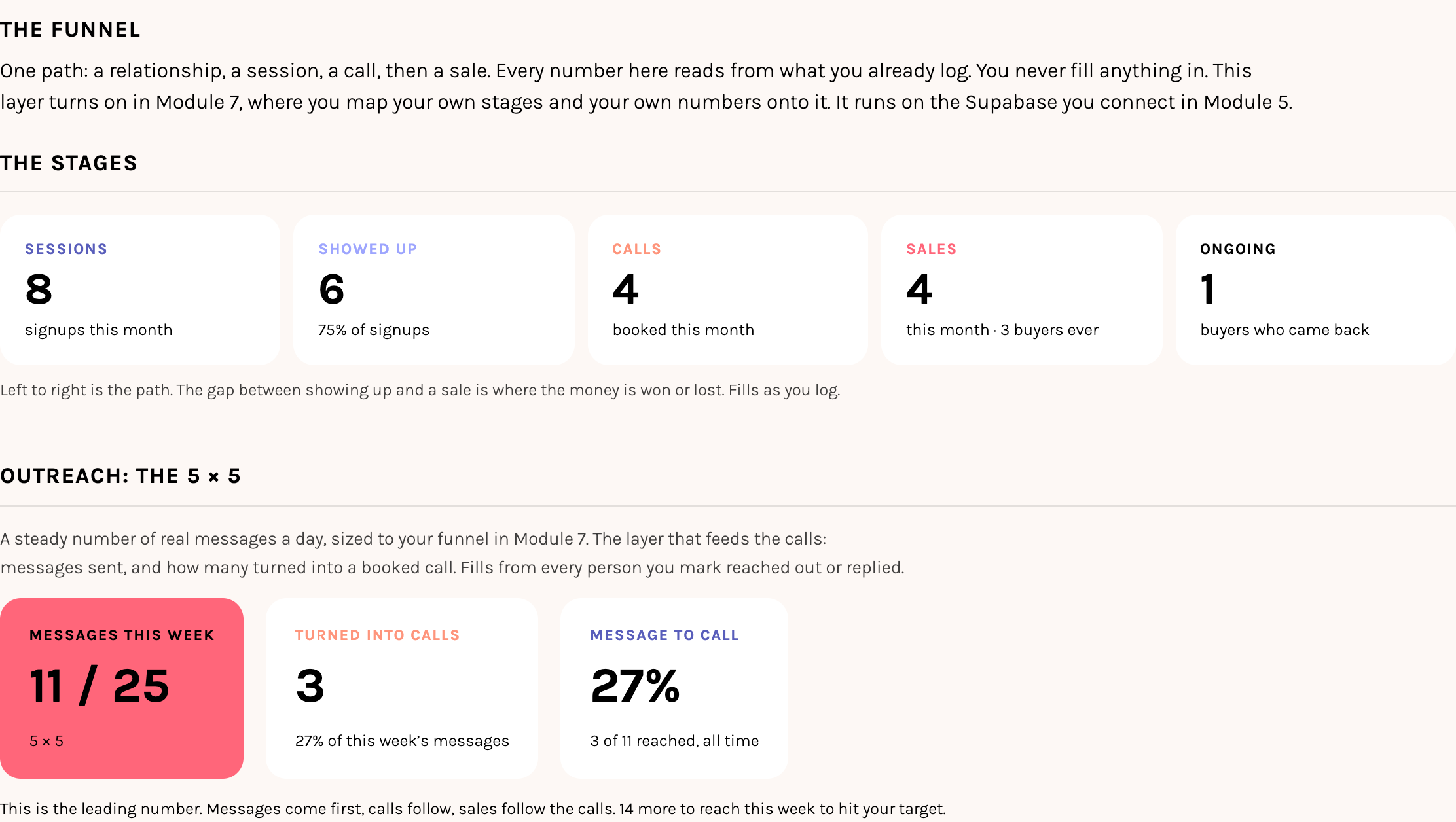
On its own it runs from a small starter root. Inside a full Four Languages system it has more to read: your CRM, so a person links to their card; your dashboard, so a booked call feeds your funnel; your voice files, so the openers sound more like you every time.
The part that makes it yours
The reason mass outreach feels like mass outreach is that a script picked the people and wrote the words. Here you do both, and it does the finding and the reading around you.
It surfaces people and suggests a reason; the judgment is always yours. You see each person, read them yourself, and choose who gets your attention. It never decides a relationship for you.
The daily rhythm is a few people, not a campaign. The whole thing is built to hold you at the pace where the outreach still sounds like you, instead of pushing you into volume.
Every person carries an honest one-line reason, and every opener references something genuine. It never invents a person, a detail, or a shared connection that was not there.
It cannot watch LinkedIn for you or message anyone on your behalf, and it will not ping you between sessions. It works when you sit down with it. The morning card is your reminder because you run it, and every message leaves from your own hands, because a system that quietly reaches out for you is a system that costs you the relationships.
A peek inside
Plain files that drop into your root system, in folders you own and can open in anything.
The promises
Built the same way as the rest of your system, because it is your name and your relationships on the line.
It helps you find and understand people, and stops there. You do the reaching out, in your own words, from your own account. It does not scrape, connect, or send.
It drafts from how you actually talk, and your edit is the last word. Approving one message never approves the next; every one passes through your hands before it leaves.
A short list over a long one, on purpose. It keeps you where the reaching out stays genuine instead of pushing you past it.
Your list and your history are your data, under your own keys. Not held on a platform you rent by the month and cannot leave with.
How to use it
It adds to your system. After a short setup, finding is a few minutes and the daily rhythm is a handful of people.
Download and unzip into your root folder. It reads what you already have, your CRM, your voice, your dashboard, and fits in where it belongs. No full system yet? It brings a small starter so it runs on its own.
A short fit block: what you do, who your work is for, the signals that make someone worth a real conversation. The truest version comes from your real best clients, not imagination, and it helps you write it.
Run find-aligned-people for open-web finds, build-your-list to read your orbit, connect-with-5 each morning, log-outreach for the conversations that happen off the card, outreach-check each evening. A few people a day, five days a week, and it remembers the rest.
# one line in your root CLAUDE.md, once the pack is in
- Aligned Outreach: when I say "who should I reach out to",
read aligned-outreach's skills and run them.
A short list you actually chose, each person worth the message, written by you. A few people a day is the whole practice, and it is the kind that still works. ❤️
Add it to your systemWant to build it live with us instead? Join the co-build on July 30.